
Bumper Block Installation for Commercial Parking Lots
Bumper blocks prevent vehicles from overrunning parking spaces and damaging property, pedestrian walkways, and landscaping. UrbanMark supplies and installs commercial-grade bumper blocks for properties across the Niagara Region, Hamilton, Haldimand County, and Halton Region.
- Protects property and pedestrians
- Concrete and rubber options
- Professional supply and installation

A Simple Parking Lot Addition That Prevents Costly Problems
Bumper blocks, also referred to as wheel stops, parking curbs, or car stops, serve one straightforward purpose: they prevent vehicles from rolling beyond their designated parking space. Without them, cars and trucks can overshoot into sidewalks, landscaping, building facades, utility infrastructure, and neighbouring parking stalls.
It sounds minor until a vehicle pushes through a garden bed, damages a storefront wall, or clips a pedestrian walking along the front of a building. Bumper blocks eliminate that risk with a simple physical barrier placed at the head of each parking space.
Where Bumper Blocks Make the Biggest Difference
Not every parking stall needs a bumper block, but many do. The highest-priority locations include spaces that border pedestrian walkways, building entrances, retaining walls, fenced areas, and landscaped zones. Any space where a vehicle rolling too far forward creates a safety hazard or property damage risk is a candidate.
Commercial plazas, retail storefronts, medical offices, and multi-tenant facilities benefit the most from bumper block installation. These properties see high daily traffic from drivers with varying levels of familiarity with the lot layout. A vehicle pulling into an unfamiliar space with no physical stop point is a liability waiting to happen.
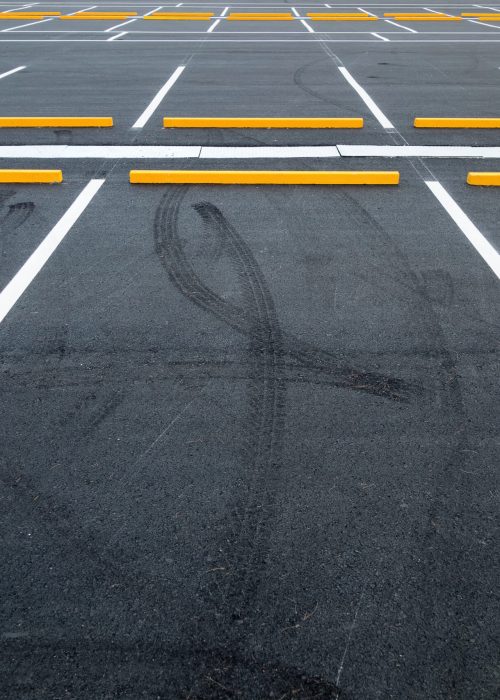
Trusted by businesses across Southern Ontario.
Concrete and Rubber Options for Different Applications
UrbanMark installs both concrete and rubber bumper blocks depending on the needs of your property. Concrete wheel stops are the industry standard for durability and weight. They stay in place under repeated impact and hold up across years of Southern Ontario freeze-thaw cycles without shifting.
Rubber bumper blocks offer a lighter alternative that still provides effective vehicle stopping power. They are commonly used in covered parking structures, lower-speed areas, and locations where a softer impact point is preferred. Both options are secured to the parking surface with rebar or hardware anchors to prevent movement over time.
Paired With Line Striping for a Complete Lot
Bumper blocks work best when installed as part of a coordinated parking lot layout. Proper placement depends on stall dimensions, traffic flow direction, and the location of adjacent infrastructure. UrbanMark frequently installs bumper blocks alongside line striping and signage projects, ensuring every element of your lot works together.
Misaligned parking curbs cause more problems than they solve. Blocks placed too far forward waste usable space. Blocks placed too far back fail to stop vehicles before they reach the hazard. Correct positioning matters, and it starts with understanding the full layout of your lot before anything gets anchored to the surface.
Replacement and Repositioning
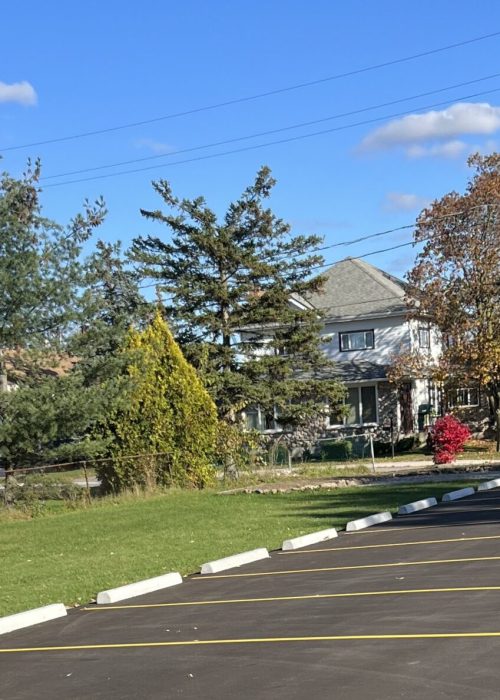
The UrbanMark Bumper Block Difference
UrbanMark does not just place blocks and walk away. We evaluate your lot layout, identify the spaces that need protection, and anchor every bumper block to the correct position for your specific stall configuration. Whether it is a handful of replacements or a full lot installation, we handle it right the first time.
Frequently Asked Questions
What is a bumper block?
A bumper block is a heavy barrier, typically made of concrete or rubber, that sits at the head of a parking space to prevent vehicles from pulling too far forward. They are also commonly called wheel stops, parking curbs, or car stops. Their purpose is to protect pedestrians, buildings, landscaping, and adjacent infrastructure from vehicle overshoot.
How are bumper blocks secured to the parking surface?
Bumper blocks are anchored to asphalt or concrete surfaces using rebar pins or heavy-duty hardware fasteners. Proper anchoring prevents the blocks from shifting under repeated vehicle contact and ensures they stay in position through seasonal ground movement.
Should every parking space have a bumper block?
Not necessarily. Bumper blocks are most important in spaces that border sidewalks, building walls, landscaping, or pedestrian areas. UrbanMark can assess your lot and recommend placement based on where the actual risk points are, rather than installing them where they are not needed.
Can bumper blocks be installed at the same time as line striping?
Yes. Combining bumper block installation with line marking is the most efficient approach and ensures proper alignment between stall markings and block placement. Many of our commercial clients bundle these services into a single project.
What areas does UrbanMark service for bumper block installation?
We provide bumper block supply and installation for commercial properties throughout the Niagara Region, Haldimand County, the Hamilton area, and Halton Region. Contact us at 905-341-7325 to confirm availability for your location.
Our Bumper Block Service Area
Urbanmark Asphalt Maintenance is based in Niagara Falls, Ontario and operates throughout Southern Ontario around the Golden Horseshoe region from Grimsby to Oakville, and everywhere in between, including:
Niagara Region
- Niagara Falls
- St. Catharines
- Welland
- Port Colborne & More
Greater Hamilton Area
- Hamilton
- Binbrook
- Stoney Creek
- Grimsby & More
Haldimand County
- Caledonia
- Jarvis
- Cayuga
- Dunnville & More
Halton Region
- Burlington
- Oakville
- Milton
- Aldershot & Area
